What is bitumen roofing? It is any roofing system that uses bitumen, the thick, black, waterproof binder refined from crude oil and known in North America as asphalt, as its main waterproofing material. The term covers three main low-slope systems: built-up roofing (BUR), modified bitumen, and roll roofing. Asphalt shingles on pitched roofs are bitumen products too.
All of these share the same basic idea: layers of reinforcing mat or felt are coated with or glued together by bitumen, then protected on top with gravel, granules, or a cap sheet. Where they differ is in how many layers they use, how they are installed, how much slope they need, and how long they hold up to weather and foot traffic.
In this article
- What is bitumen roofing? The basics
- Bitumen vs. asphalt vs. coal tar
- Built-up roofing (BUR)
- Modified bitumen roofing
- Asphalt roll roofing
- Where asphalt shingles fit in
- Bitumen roofing types compared
- Pros and cons of bitumen roofing
- Where bitumen roofing is used
- How to choose the right bitumen roof
- Inspecting and maintaining a bitumen roof
- Frequently Asked Questions
What is bitumen roofing? The basics
Bitumen is a sticky, highly water-resistant hydrocarbon material. In roofing it does two jobs: it keeps water out, and it glues the layers of the roof together. On its own, bitumen would crack in cold weather, soften in heat, and break down in sunlight, so roofing products always combine it with something else:
- Reinforcement, such as fiberglass mat, polyester mat, or felt, which gives the material strength and keeps it from cracking or tearing.
- Surfacing, such as gravel, mineral granules, or a reflective coating, which protects the bitumen from UV, fire, and physical damage.
- Modifiers in some products, such as polymers that make the bitumen more flexible or more heat resistant.
Bitumen has been used on roofs for well over a century. Its staying power comes from being relatively inexpensive, easy to repair with compatible materials, and forgiving on roofs where water doesn’t drain off quickly.
Bitumen vs. asphalt vs. coal tar
These three words get mixed up constantly, so it helps to separate them.
Bitumen and asphalt
In roofing, bitumen and asphalt mean the same thing. Asphalt is a product of crude oil refining. “Bitumen” is the more common term internationally and in product names such as “modified bitumen,” while “asphalt” is the everyday word in the United States, as in “asphalt shingles” and “hot asphalt.”
Coal tar pitch
Coal tar pitch is also a bituminous material, but it comes from coal, not petroleum. It was widely used in older built-up roofs and is still used in some commercial systems. Coal tar and asphalt are chemically incompatible, so a repair on a coal tar roof must use coal tar materials and an asphalt roof must use asphalt materials. A roofer can tell them apart with a simple solvent test: asphalt dissolves in mineral spirits, while coal tar does not.
That is why “tar roof” is a loose term. Many roofs people call tar-and-gravel are actually asphalt built-up roofs.
Built-up roofing (BUR)
Built-up roofing, often called BUR or tar-and-gravel, is the oldest bitumen system still in common use. It is “built up” on the roof from alternating layers of bitumen and reinforcing felts.
How BUR is constructed
- Base sheet: a heavier sheet fastened or adhered to the deck or insulation.
- Ply sheets: several layers of felt, today usually fiberglass, each set in a layer of bitumen. A typical built-up roof has three to five plies.
- Bitumen: usually hot asphalt melted in a kettle and mopped on, though cold-applied adhesive versions exist.
- Surfacing: a flood coat of bitumen with gravel or slag embedded in it, a mineral-surfaced cap sheet, or a reflective coating.
The multiple plies give BUR built-in redundancy. If the top layer is damaged, there are still layers below it holding back water.
Where BUR is used
BUR is mostly found on commercial buildings, older apartment buildings, and some flat-roofed homes and garages. Under the International Residential Code, built-up roofs need a design slope of at least 1/4 inch per foot for drainage, or 1/8 inch per foot for coal tar systems.
BUR drawbacks
BUR is heavy, especially with gravel surfacing, and the quality depends heavily on the crew and kettle conditions on the day it is installed. Hot asphalt work involves fumes and burn risks, and heated asphalt fumes are considered a potential occupational carcinogen by NIOSH. Oxidized asphalt used in BUR also becomes brittle when cold, which is one reason modified bitumen has taken over much of its market.
Modified bitumen roofing
Modified bitumen, or mod-bit, is asphalt blended with polymers to make it perform better, then formed into factory-made rolls with a polyester or fiberglass reinforcing mat. It was developed in Europe in the 1960s and reached the U.S. commercial market in the late 1970s. Think of it as a factory-made upgrade to built-up roofing: fewer layers on the roof, but each layer is thicker and tougher.
A typical mod-bit roof is a two-ply system: a base sheet and a granule-surfaced cap sheet. The two main modifiers are:
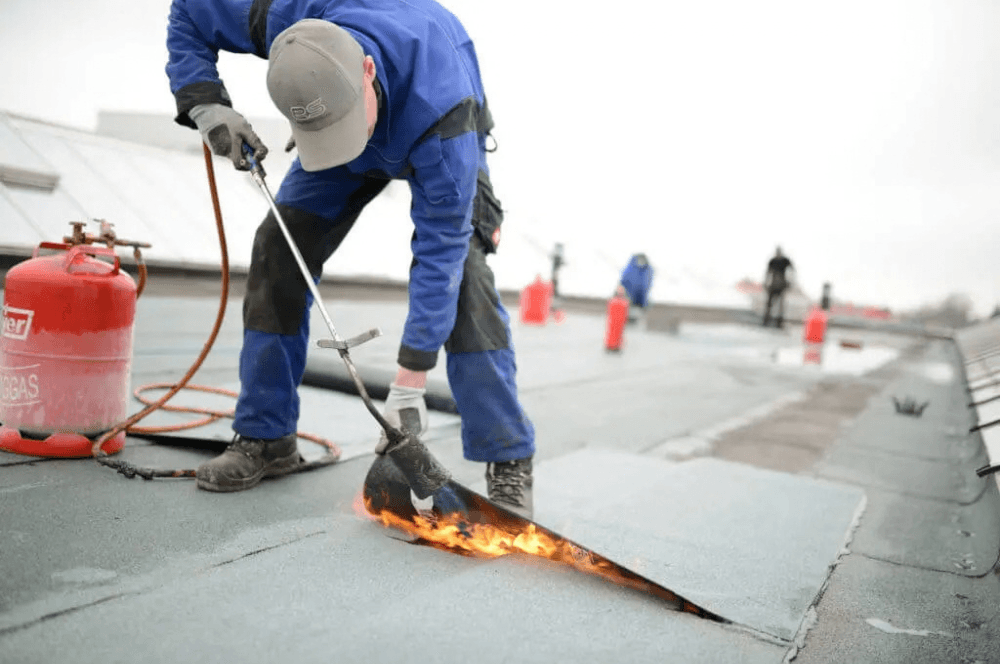
- SBS (styrene-butadiene-styrene): a rubber-like polymer that lets the membrane stretch and recover. Manufacturer data shows SBS-modified bitumen stays flexible to below -20°F, which makes it a strong fit for cold climates. SBS sheets can be applied with hot asphalt, cold adhesive, a torch, or a self-adhesive backing.
- APP (atactic polypropylene): a plastic-type polymer that improves heat and UV resistance. APP is typically torch-applied, and APP-modified asphalt becomes brittle below about 23°F.
Like BUR, modified bitumen needs a design slope of at least 1/4 inch per foot under the International Residential Code. This is a quick overview; the details of SBS vs. APP sheets, application methods, and repairs deserve their own deep dive.
Asphalt roll roofing
Roll roofing is the simplest and least expensive bitumen roofing. It is essentially the same material as an asphalt shingle, an asphalt-coated mat with mineral granules on top, made in long rolls instead of individual shingles.
Common types
- Mineral-surfaced roll roofing: rolls are typically 36 inches wide. One Owens Corning product, for example, covers 100 square feet per roll, one roofing “square.”
- Selvage-edge (double-coverage) roll roofing: about half the width is granule-surfaced and the other half is a bare selvage edge that the next course overlaps. TAMKO’s 19-inch selvedge roll, for example, has a 17-inch exposure and covers about half a square per roll, because every spot on the roof ends up with two layers.
Where roll roofing works
Roll roofing is mainly used on sheds, garages, workshops, porches, and other outbuildings, or as an economical low-slope covering. Under the International Residential Code, mineral-surfaced roll roofing cannot be installed on slopes less than 1 inch per foot. TAMKO’s product data uses the same minimum.
The trade-off is durability and appearance. Roll roofing is a single thin layer, or two with double coverage, so it’s less robust than BUR or mod-bit, more prone to cracking and wind damage, and noticeably plain on a home. For step-by-step details, see our guide on how to install roll roofing.
Where asphalt shingles fit in
Asphalt shingles are the most common bitumen roofing product of all, though people rarely call them that. They use the same ingredients as roll roofing, a fiberglass mat, asphalt, and mineral granules, but they are cut into individual pieces that overlap to shed water.
Because shingles shed water rather than forming a sealed membrane, they need more slope. The International Residential Code allows asphalt shingles only on slopes of 2 inches per foot or more, and slopes between 2:12 and 4:12 require a double layer of underlayment. Below 2:12, a low-slope bitumen membrane such as BUR or mod-bit is the right choice. If you’re curious about shingle roofs specifically, our guide on how roofing shingles are installed walks through the process.
Bitumen roofing types compared
| Type | Construction | Typical install method | Minimum slope (IRC) | Best for |
|---|---|---|---|---|
| Built-up roofing (BUR) | 3–5 plies of felt set in bitumen, surfaced with gravel or a cap sheet | Hot-mopped asphalt or cold adhesive | 1/4 in. per ft (1/8 in. for coal tar) | Commercial and multi-family flat roofs, high-traffic roofs |
| Modified bitumen | Factory-made polymer-modified sheets, usually base sheet plus cap sheet | Torch, hot asphalt, cold adhesive, or self-adhered | 1/4 in. per ft | Residential and commercial flat roofs, cold climates (SBS) |
| Roll roofing | Single mineral-surfaced sheet, or selvage-edge sheets lapped for two layers | Nailed, with lap cement or adhesive per the manufacturer | 1 in. per ft | Sheds, garages, outbuildings, budget low-slope roofs |
| Asphalt shingles | Individual overlapping shingles over underlayment | Nailed, with self-sealing strips | 2 in. per ft | Pitched residential roofs |
Pros and cons of bitumen roofing
Advantages
- Proven waterproofing. Bitumen has protected roofs for well over a century, and BUR and mod-bit are designed to hold up on roofs with very little slope.
- Redundancy. Multi-ply systems keep working even if the top layer is damaged.
- Toughness. Granule or gravel surfacing resists foot traffic, hail, and punctures better than many thin membranes.
- Repairability. Damaged areas can usually be patched with compatible bitumen materials.
- Cost. Roll roofing in particular is one of the least expensive roof coverings available, and BUR has long been considered an economical low-slope system.
Disadvantages
- Installation hazards. Hot asphalt kettles and torch-applied membranes involve fire and burn risks and require trained crews. Self-adhered and cold-applied products avoid open flames.
- Weight. Gravel-surfaced BUR is heavy, which matters for older or lightly framed roofs.
- Heat absorption. Dark surfaces absorb sunlight unless a reflective cap sheet or coating is used.
- Cold sensitivity. Unmodified and APP-modified asphalt become brittle in cold weather. SBS handles cold much better.
- Ponding water. No bitumen roof should sit under standing water for long. Poor drainage shortens its life, so slope and drains matter as much as the membrane.
- Odor and fumes during hot or torch application.
Where bitumen roofing is used
- Commercial and industrial roofs: BUR and modified bitumen are both widely used on low-slope commercial roofs. See our commercial roofing page for more on these buildings.
- Residential flat and low-slope roofs: porches, additions, row houses, flat-roofed modern homes, and attached garages often use modified bitumen.
- Outbuildings: sheds, detached garages, and workshops commonly use roll roofing.
- Pitched homes: asphalt shingles, plus self-adhering bitumen membranes used as ice barrier at eaves and in valleys.
- Waterproofing details: bitumen-based flashing cements, coatings, and membranes appear on nearly every type of roof.
How to choose the right bitumen roof
The right bitumen roof depends on the building more than on the material itself. Work through these questions:
- What is the slope? Under 1/4 inch per foot, the roof needs tapered insulation or framing changes to drain properly. Between 1/4 and 1 inch per foot, BUR or mod-bit is the realistic choice. Roll roofing needs at least 1 inch per foot, and shingles at least 2 inches per foot.
- How is the roof used? Roofs with frequent foot traffic, rooftop equipment, or decks benefit from tougher multi-ply systems.
- What is the climate? In cold regions, SBS-modified bitumen’s low-temperature flexibility is a real advantage.
- Are open flames a concern? On wood-framed homes or roofs with many penetrations, cold-applied or self-adhered systems avoid torch risks.
- Can the structure carry the weight? Gravel-surfaced BUR is much heavier than a two-ply mod-bit system.
- What is underneath? Wet insulation or a damaged deck should be replaced, not covered over. Local code also limits how many roof layers are allowed.
- What does the manufacturer require? Each system has specific requirements for base sheets, fasteners, adhesives, and flashing. Following them matters for performance and for the manufacturer’s warranty.
Our overview of flat roofing systems goes into more detail on low-slope options beyond bitumen.
Inspecting and maintaining a bitumen roof
Bitumen roofs last longest when small problems are caught early. Look for these signs, ideally from the ground or a secure vantage point, and leave anything that requires walking the roof to a professional with proper fall protection:
- Blisters and bubbles, often caused by moisture or air trapped between layers.
- Cracking or “alligatoring” of the surface, a sign the bitumen is drying out and losing its protective surfacing.
- Bare spots where gravel or granules have washed or worn away, exposing bitumen to UV.
- Open laps and seams, especially on roll roofing and at mod-bit seams.
- Failing flashings at walls, curbs, vents, and drains, where most leaks start.
- Ponding water that remains well after rain, which points to drainage problems.
Keep drains, scuppers, and gutters clear, and have a low-slope roof inspected regularly and after major storms. Repairs should use materials compatible with the existing bitumen, asphalt on asphalt and coal tar on coal tar.
Frequently Asked Questions
Is bitumen the same as asphalt?
In roofing, yes. “Bitumen” is the term used in much of the world, while “asphalt” is the usual North American word for the same petroleum-based binder used in shingles, built-up roofs, modified bitumen, and roll roofing.
Is bitumen roofing the same as tar roofing?
Not exactly. People often call any black flat roof a “tar roof,” but coal tar pitch is a different, coal-derived material that is chemically incompatible with asphalt. Most bitumen roofing today is asphalt-based, and repairs must use the same type of bitumen as the existing roof.
What is the minimum slope for bitumen roofing?
Under the International Residential Code, built-up and modified bitumen roofs need a design slope of at least 1/4 inch per foot, coal-tar built-up roofs at least 1/8 inch per foot, mineral-surfaced roll roofing at least 1 inch per foot, and asphalt shingles at least 2 inches per foot.
Is bitumen roofing waterproof?
Built-up and modified bitumen membranes are designed to be waterproof on low-slope roofs when they are properly installed with sealed laps and flashings. Roll roofing and asphalt shingles shed water rather than forming a fully sealed membrane, which is why they need more slope.
What is the difference between SBS and APP modified bitumen?
SBS uses a rubber-like polymer that stays flexible in cold weather and is applied with hot asphalt, adhesives, torches, or self-adhesive backing. APP uses a plastic polymer that resists heat and UV well and is typically torch-applied.
Can bitumen roofing be installed over an old roof?
Sometimes, but it depends on the condition of the existing roof, how many layers are already there, and local code. Wet insulation or a deteriorated deck usually has to be removed first, so a roofer should inspect the roof before deciding.
Bitumen roofing is a family, not a single product: built-up roofing for proven multi-ply protection, modified bitumen for tougher factory-made sheets, roll roofing for simple outbuildings, and asphalt shingles for pitched homes. Matching the system to the roof’s slope, use, and climate is what makes it last. If you’d like a professional opinion on a worn or leaking low-slope roof, see our flat roof repair page.