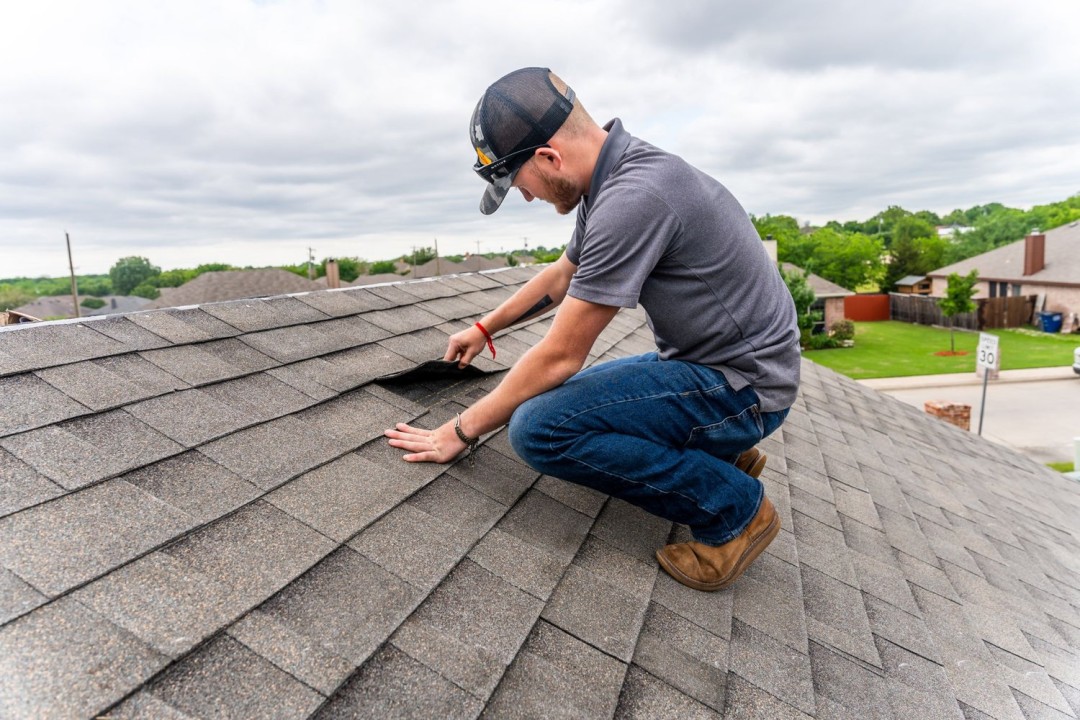
Class 4 shingles are roof shingles that earned the highest rating in the UL 2218 impact test: a 2-inch steel ball dropped twice on the same spot without cracking or tearing the shingle. For most Minnesota homeowners who are already replacing a roof, they are worth a serious look, because hail is a regular summer threat here and the price premium over comparable shingles is often modest.
They are not hail-proof, though. Independent research from the Insurance Institute for Business & Home Safety (IBHS) shows that impact-resistant shingles vary a lot from brand to brand, and that aging and repeated small hail wear down their resistance. This guide explains what the Class 4 label really means, what the research shows, how Minnesota’s insurance rules work, and how to decide whether the upgrade makes sense for your house.
In this article
- What Are Class 4 Shingles?
- How the UL 2218 Impact Test Works
- FM 4473: The Ice-Ball Test
- What IBHS Research Shows About Real Hail
- Hail Risk in Minneapolis and Minnesota
- Minnesota Insurance Discounts and the Strengthen Minnesota Homes Program
- What Do Class 4 Shingles Cost?
- Are Class 4 Shingles Worth It in Minnesota?
- How to Choose an Impact-Resistant Shingle
- Frequently Asked Questions
What Are Class 4 Shingles?
“Class 4” is an impact rating, not a type of shingle. It tells you how a roofing product performed in a standardized laboratory test that simulates hail by striking a sample with a hard ball. Products are rated from Class 1 (lowest) to Class 4 (highest), and Class 4 is the top tier.
Two test standards are used in the U.S.:
- UL 2218, which drops steel balls on the roof covering. This is the rating you’ll see on most asphalt shingles and many metal roofing products.
- FM 4473, which fires balls of ice at the sample. It is aimed mainly at rigid roofing such as slate, clay tile and concrete tile.
Impact-resistant (IR) asphalt shingles reach a Class 4 rating in different ways. Many use polymer-modified asphalt, which makes the shingle more flexible so it absorbs a strike instead of cracking. Older designs relied on a reinforcing fabric (scrim) on the back. That difference matters, as the IBHS research below shows.
How the UL 2218 Impact Test Works
UL 2218 is the standard most people mean when they say “Class 4.” A 3-by-3-foot sample of new, unweathered roofing is installed on a test deck. Steel balls of a set size are then dropped onto it from a height chosen so that the ball hits with roughly the energy of a hailstone of the same size.
| UL 2218 class | Steel ball diameter |
|---|---|
| Class 1 | 1¼ inches |
| Class 2 | 1½ inches |
| Class 3 | 1¾ inches |
| Class 4 | 2 inches (dropped from 20 feet) |
What it takes to pass
The ball is dropped twice on the same spot at each of several impact locations, chosen because they look like the weakest points (such as edges, joints and areas over gaps). To pass, the sample must show no tearing, fracturing, cracking, splitting, rupturing or crazing on the top surface, the back surface or the layers beneath.
Cosmetic marks do not count as failure. That’s an important detail for metal roofing: a Class 4 metal panel can still dent, because a dent that doesn’t open the panel to water is considered cosmetic under the standard.
What UL 2218 does not tell you
The test uses brand-new material in lab conditions and steel balls rather than ice. Real hail is irregular, can shatter or turn slushy on impact, and hits roofs that have been baking in the sun and freezing for years. A pass/fail rating also doesn’t show how much better one Class 4 product is than another. Those gaps are why IBHS developed its own test.
FM 4473: The Ice-Ball Test
FM 4473, from FM Approvals, launches pre-molded ice balls at a 3-by-3-foot sample. The ice balls come in the same four sizes as UL 2218, from 1¼ inches for Class 1 to 2 inches for Class 4, and the launcher is calibrated so each strike delivers a target amount of energy. For Class 4, the target is about 26.8 foot-pounds.
To pass, the sample must show no visible cracking or breakage after two impacts in the same spot. Because the standard focuses on rigid materials, you’re most likely to see an FM 4473 rating on slate, concrete tile or clay tile, though some manufacturers list it for shingles too. Either rating counts as “impact-rated” in the IBHS program.
What IBHS Research Shows About Real Hail
IBHS is an independent research group funded by the insurance industry. It runs a large lab in South Carolina where it makes realistic hailstones and fires them at roofing products bought from ordinary retail suppliers, the same way a homeowner or roofer would buy them.
Not all Class 4 shingles perform the same
An early IBHS study tested shingles under UL 2218 conditions and found that no product, including impact-rated ones, got past Class 2 impacts without at least one double-impact location failing. Class 4 pass rates by impact location ranged from about 25% for basic 3-tab shingles to about 55% for polymer-modified impact-resistant shingles. In other words, a lab-labeled Class 4 product doesn’t pass every possible impact.
IBHS now says plainly that many Class 4 impact-resistant shingles don’t perform as expected in real storms. Since 2019 it has used lab-made hailstones instead of steel balls and measures how much damage occurs, rather than pass/fail.
The IBHS shingle ratings
IBHS rates impact-resistant shingles as Excellent, Good, Marginal or Poor, based on dents and ridges, tears and granule loss. Its fourth edition, released in November 2025, covered 24 products representing about 95% of impact-resistant shingles sold each year. Most earned “Good,” and none earned “Excellent.” IBHS’s guidance is direct: if a product rates Marginal or Poor, it does not recommend using it in areas that get hail.
Earlier rounds found that every impact-rated shingle that scored Good or Excellent against 2-inch hail used polymer-modified asphalt, and that dents and ridges were the weakest category across products. That matters because dents, ridges and tears are the damage types most closely tied to leaks.
Aging and small hail wear resistance down
IBHS tests new shingles, but it is also studying how they age. Early results from its roof aging program show that even short-term natural weathering can measurably reduce hail impact performance.
A 2025 IBHS study looked at “sub-severe” hail, meaning stones under 1 inch. Repeated small impacts knocked off more granules in total than a single 2-inch hailstone, and shingles exposed to both weathering and small hail were about ten times more susceptible to damage from a later severe storm. Impact-resistant shingles did only slightly better than conventional shingles on granule loss from small hail.
The takeaway: a Class 4 roof gives you a real advantage against the big storms, but it still needs hail damage inspection and repair after major events, and it won’t stay as tough at year 15 as it was on day one.
Hail Risk in Minneapolis and Minnesota
Minnesota’s hail season typically starts in late May in the southern part of the state and early June in the north, according to University of Minnesota climatologist Mark Seeley. Storms continue through summer. The Twin Cities metro is no exception: in a July 2009 storm, for example, the Minnesota DNR recorded quarter- to half-dollar-size hail across the eastern metro and golf-ball-size hail in Maplewood.
Hail that size is right in the range the Class 4 test is built around. Minnesota roofs also deal with freeze-thaw cycles and ice dams, which age shingles and can widen any cracks hail leaves behind. For a house that will stay in the family for years, those two pressures together are the main argument for a tougher roof covering.
Minnesota Insurance Discounts and the Strengthen Minnesota Homes Program
This is where a lot of homeowners get confused, because there are two different things: insurer discounts for impact-resistant shingles, and the state’s FORTIFIED roof law.
Voluntary discounts for impact-resistant roofs
Many insurance companies offer a premium discount or better terms for an impact-resistant roof. Whether you qualify, and by how much, depends on your insurer and policy. Before you choose shingles, ask your agent:
- Do you give a discount for a UL 2218 Class 4 (or FM 4473 Class 4) roof, and how much is it on my policy?
- What proof do you need? (Usually the product wrapper, the manufacturer’s product data or the contractor’s invoice showing the exact product.)
- Does my policy handle cosmetic hail damage, such as dents on metal, differently from functional damage?
- Would a FORTIFIED designation earn a larger discount?
The FORTIFIED discount required by state law
Minnesota passed a law in 2023 (Minn. Stat. § 65A.298) that requires insurers to offer a premium discount or rate reduction for homes that meet the IBHS FORTIFIED standard including its hail supplement, whether the home is new or retrofitted. The owner has to provide the IBHS certificate, and the discount applies to policies that include wind coverage. Insurers file their own rating plans, so the amount varies by company.
Simply installing Class 4 shingles does not by itself trigger this legal requirement. A FORTIFIED Roof involves a package of upgrades (such as better deck attachment and a sealed roof deck) that must be documented by an IBHS-approved evaluator. For the hail supplement, a shingle roof must use a product rated Good or Excellent on the IBHS hail impact ratings.
Strengthen Minnesota Homes grants
The same 2023 legislation created the Strengthen Minnesota Homes program at the Minnesota Department of Commerce to help pay for FORTIFIED roofs. Commerce projects grants of about $10,000 per qualifying single- or two-family home, which may not cover the full cost of the upgrade. A home has to be inspected by a FORTIFIED evaluator, and the work must be done by an approved FORTIFIED roofing provider.
So far the program has run as a limited pilot. In 2026 Commerce began a pilot within its Weatherization Assistance Program framework, and as of spring 2026 the program had not received state funding to distribute grants broadly. Check the Strengthen Minnesota Homes page on the Commerce website for current eligibility and status before counting on a grant.
What Do Class 4 Shingles Cost?
IBHS compared retail shingle prices as part of its ratings work and found that impact-resistant shingles rated Good or Excellent cost about 9% more per roofing square on average than comparable non-impact-rated shingles. The gap varied by market: it was only about 2% in Oklahoma City and 4% in Dallas–Fort Worth, where impact-resistant shingles are common, and wider in regions where they’re harder to find.
That figure covers material only. Your installed price also depends on roof size, pitch, tear-off layers, deck repairs, flashing and ventilation work. Treat any percentage as a national ballpark that varies by project; a written estimate is the only way to know your real number. Our roof replacement cost guide explains what drives the total.
Are Class 4 Shingles Worth It in Minnesota?
For most Twin Cities homeowners who are already replacing a roof, Class 4 shingles are worth considering. The case is strongest when the extra cost is small and you plan to stay in the home.
Reasons the upgrade usually pays off
- Hail is a real, recurring risk. Minnesota sees hail every summer, and large hail is exactly what the test simulates.
- The premium can be small. IBHS found an average material difference of about 9% for well-rated products.
- Possible insurance savings. A discount, even a modest one, repeats every year you keep the policy.
- Fewer claims and disruptions. A roof that shrugs off a moderate storm saves you a deductible, paperwork and the hassle of a repair crew.
- A path to FORTIFIED. If you choose an IBHS Good or Excellent product, the roof can be part of a FORTIFIED hail designation later.
When it may not be worth it
- You plan to sell soon and the buyer pool in your area won’t value the upgrade.
- Your insurer offers no discount and the price gap from your contractor is large.
- The product you’re offered is Class 4 but rates Marginal or Poor with IBHS.
- You’re repairing a small area; mixing impact-resistant and standard shingles on one slope doesn’t give you the benefit.
How to Choose an Impact-Resistant Shingle
- Confirm the rating. Look for UL 2218 Class 4 or FM 4473 Class 4 on the bundle wrapper or the manufacturer’s product data sheet, not just a sales brochure.
- Check the IBHS rating. Prefer products rated Good or Excellent on the IBHS impact-resistant shingle ratings, and avoid Marginal or Poor products.
- Ask about construction. Polymer-modified asphalt has performed best in IBHS testing.
- Match the system. Use the manufacturer’s starter strips, ridge caps and nailing pattern so the whole roof performs as tested and stays eligible for the manufacturer’s limited warranty.
- Don’t skip ventilation and ice protection. In Minnesota, balanced attic ventilation and ice-barrier underlayment at the eaves protect the roof as much as the shingle itself. Your local building department sets the code requirements.
- Read the warranty. Check what the manufacturer’s limited warranty says about hail, if anything. Terms differ between brands and product lines, so know what’s covered before you buy.
Proper installation is part of the rating. Our roof installation page covers what a complete new roof system includes.
Frequently Asked Questions
Are Class 4 shingles hail-proof?
No. Class 4 means a new shingle withstood two strikes from a 2-inch steel ball in a lab test. Large or repeated hail, aging and installation problems can still damage a Class 4 roof.
Do Class 4 shingles lower insurance premiums in Minnesota?
Many insurers offer a discount for impact-resistant roofs, but the amount depends on the company and policy. Minnesota law specifically requires insurers to offer a discount for roofs that earn the IBHS FORTIFIED designation with the hail supplement.
What is the difference between UL 2218 and FM 4473?
UL 2218 drops steel balls on the roofing and is used for most shingles and metal panels. FM 4473 fires ice balls and is aimed mainly at rigid materials like slate and tile. Both use four classes, with Class 4 the highest.
Can a Class 4 metal roof still dent?
Yes. UL 2218 counts only cracks, tears and openings as failure, so a dent that doesn’t let water in is considered cosmetic. Ask your insurer how your policy treats cosmetic hail damage.
How much more do impact-resistant shingles cost?
IBHS found that impact-resistant shingles rated Good or Excellent cost about 9% more per square on average than comparable standard shingles, with wide regional differences. Installed prices vary by project, so get a written estimate.
Do I need to replace my whole roof to get Class 4 shingles?
To get the benefit and any insurance credit, the whole roof covering generally needs to be an impact-rated product. Patching a few impact-resistant shingles into an older standard roof won’t change how the rest of the roof handles hail.
Do Class 4 shingles look different from regular shingles?
Most don’t. Manufacturers make impact-resistant versions of standard architectural shingles in similar colors and profiles, so the difference is in the materials, not the look.
Class 4 shingles are not magic, but for a Minnesota home facing hail every summer, a well-rated impact-resistant roof is one of the most practical upgrades you can make when it’s time to replace. Check the IBHS ratings, talk to your insurance agent, and compare written estimates before you decide.
Want to compare standard and impact-resistant shingles for your home? Call Minneapolis Roofing Company at (888) 657-0348 for a free estimate.