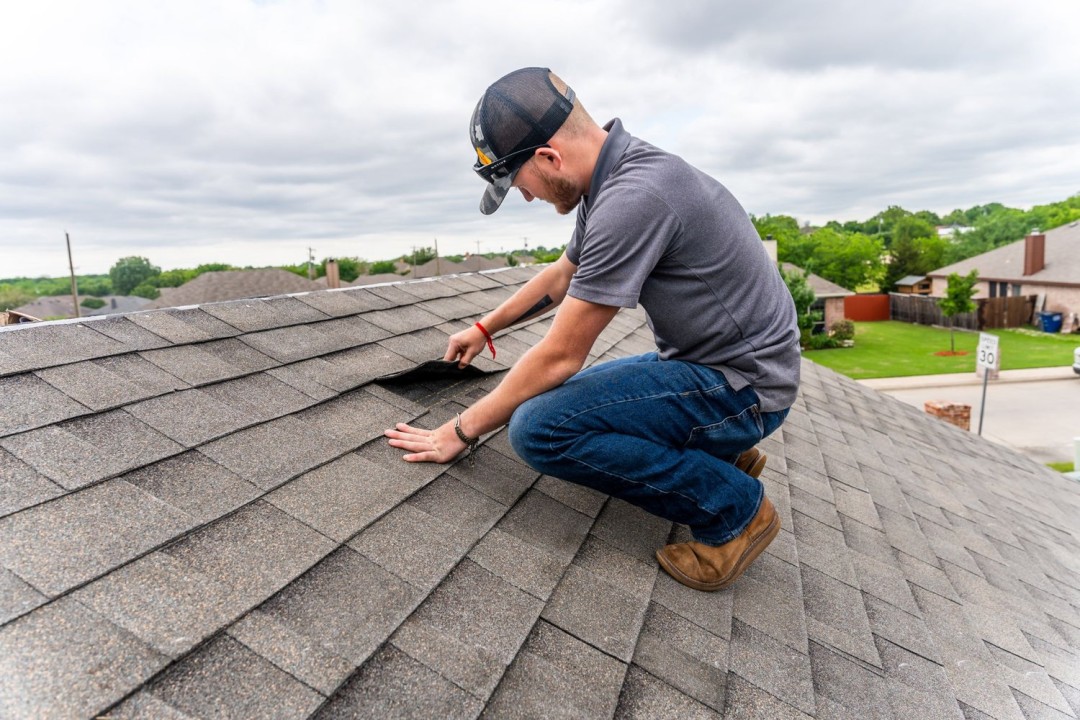
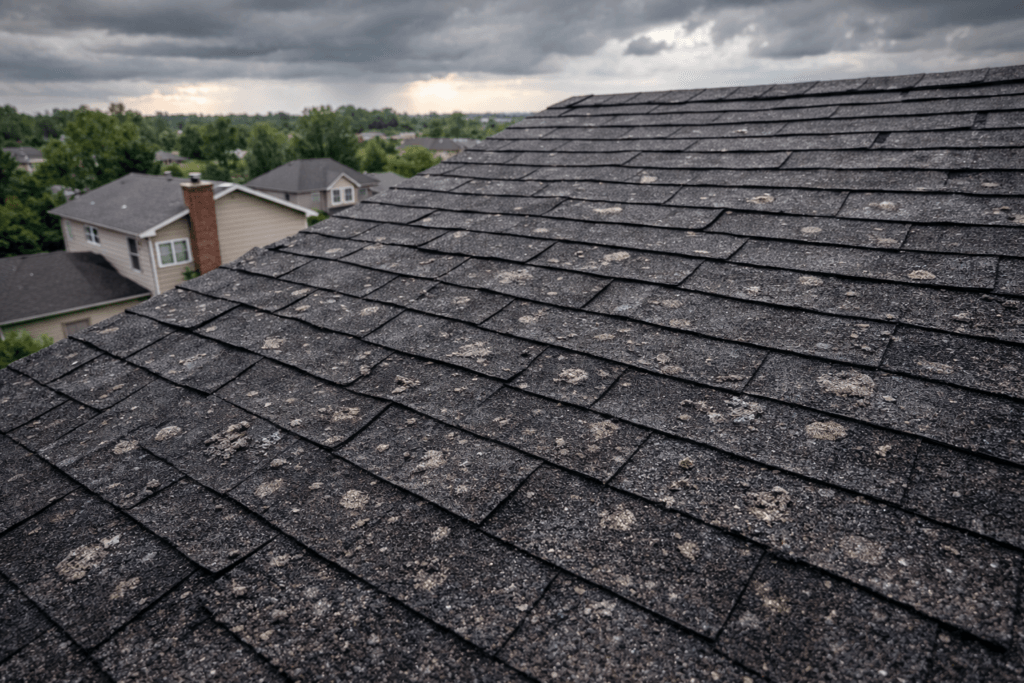
The most common signs of hail damage on roof shingles are scattered dark spots where granules were knocked off, soft “bruises” that feel spongy when pressed, and cracked or broken shingles, especially along the ridge caps. Because you shouldn’t climb up to look, the best early clues are at ground level: fresh dents in gutters, downspouts, roof vents and other soft metals, plus piles of shingle granules at downspout outlets.
This guide explains what hail damage actually looks like, which ground-level checks are worth doing after a Minneapolis storm, how to tell hail from normal wear, and when to bring in a professional for a closer look.
In this article
- What Hail Damage Looks Like on Shingles
- Ground-Level Checks You Can Do Safely
- What Size Hail Damages a Roof?
- Hail Damage or Normal Wear? Common Look-Alikes
- Why Hidden Hail Damage Still Matters
- Hail Season in Minneapolis and the Twin Cities
- What to Do If You See Signs of Hail Damage
- Repair or Replace After Hail?
- Frequently Asked Questions
What Hail Damage Looks Like on Shingles
Asphalt shingles are the most popular roofing product in the U.S., so they’re where homeowners most often find hail damage. According to guidance from the Insurance Institute for Business & Home Safety (IBHS) and shingle manufacturers, true hail damage has a few consistent features.
Random, scattered impact marks
Hail falls in no particular order, so the marks it leaves are random. You’ll see impacts of different sizes spread across a slope, not lined up in rows or concentrated only along edges. IBHS points to a scattered, irregular pattern as one of the clearest ways to separate hail from other causes. A neat, repeating pattern usually points to something else, such as installation marks or a manufacturing issue.
Hail bruising
A hail bruise is a spot where the impact crushed or fractured the shingle’s mat underneath the surface. Inspectors identify hail bruising by touch: the spot feels soft or gives slightly under light pressure, almost like a bruise on an apple. A bruise may look like nothing more than a dark spot at first, which is why a hands-on inspection by a trained roofer or adjuster matters.
Granule loss at the point of impact
The colored granules on top of a shingle shield the asphalt from the sun. When hail knocks them loose, it leaves a dark, often roughly circular patch of exposed asphalt. This kind of granule loss is concentrated at impact points rather than spread evenly over the roof. GAF notes that granules can also continue to shed in clusters from impact points over time, exposing more asphalt.
Cracks, fractures and exposed mat
Harder hits can crack shingles, with cracks radiating outward from the impact. In more severe cases the surfacing shatters and the fiberglass mat is exposed. GAF also points out that the mat can be fractured without any visible sign at first, and those hidden fractures can later turn into cracks and tears as the shingle ages.
Damaged ridge caps and loosened seal strips
Ridge caps sit at the peak of the roof, are bent over the ridge, and take hail head-on from both sides. IBHS lists them among the most hail-vulnerable parts of a shingle roof. Hail can also weaken the factory sealant strip that bonds each shingle to the one below, which can make shingles easier for wind to lift later.
Ground-Level Checks You Can Do Safely
Please don’t climb a ladder onto the roof to look for hail damage shingles problems. Shingles can be slippery after a storm, damaged areas can be weak, and a fall is far more costly than any repair. The good news is that hail strong enough to damage a roof almost always leaves evidence on things you can see from your yard, driveway or deck. IBHS calls this “collateral” evidence, and it helps confirm that hail actually hit your property.
Gutters and downspouts
Walk the perimeter of the house and look at the gutters from the ground. Aluminum gutters and downspouts dent easily, so fresh round dings along the front edge or the downspout elbows are a strong sign of hail. Look closely at the ground where each downspout empties: a pile of loose shingle granules there can suggest hail knocked them off the roof. The Nebraska Department of Insurance notes that granules at the downspout are a possible sign of damage, but not proof on their own, because new shingles also shed some loose granules and heavy rain can wash out granules too.
Roof vents and other soft metals
From a spot where you can see the roof, look at box vents, turbine vents, plumbing vent collars, chimney caps and metal flashing. These soft metals dent or show clear impact marks before shingles show obvious damage. Binoculars help. GAF’s hail bulletin specifically recommends checking metal flashings, chimney caps and skylight flashings when shingle damage isn’t obvious.
Spatter marks
Hail often knocks dirt, oxidation or paint chalk off metal and painted surfaces, leaving fresh, clean-looking splash marks. IBHS notes that spatter marks are not damage in themselves, but they are a good sign that hail fell and can show which direction the storm came from. Check the air conditioner cabinet, metal mailbox, electrical meter, painted railings and the tops of fence posts.
A/C condenser fins
The thin aluminum fins on an outdoor air conditioner bend easily. A fresh pattern of dents on the top or the storm-facing side is one of the most reliable hail indicators at ground level.
Siding, windows, screens and outdoor items
Look for chips or cracks in vinyl siding, dents in aluminum trim, torn window screens, cracked window glazing beads, and marks on wood fences, decks and patio furniture. Cars parked outside during the storm are another good indicator. The Nebraska Department of Insurance suggests checking items like these before filing a claim, since hail strong enough to damage a roof often damages them as well.
Interior clues (later)
Hail damage doesn’t usually cause leaks right away, but cracked or fractured shingles can let water in over time. In the weeks after a storm, keep an eye on attic sheathing and insulation, ceiling stains and the area around skylights and chimneys.
| Where to look | What hail evidence looks like |
|---|---|
| Gutters and downspouts | Fresh round dents, especially on the outer lip and elbows |
| Downspout outlets | Piles of colored shingle granules (possible sign, not proof) |
| Roof vents, flashing, chimney cap | Dents or impact marks, viewed from the ground with binoculars |
| A/C condenser | Bent or dented fins on the top and storm side |
| Painted or oxidized metal | Fresh spatter marks where grime was knocked off |
| Siding, screens, fences, cars | Chips, cracks, tears and dents on the side facing the storm |
What Size Hail Damages a Roof?
There’s no single hail size that always causes roof damage. Results depend on the hailstone’s size and density, wind speed and angle, the type and weight of the shingle, and how old and weathered the roof already is. Still, a few reference points help.
The National Weather Service uses everyday objects to describe hail size:
| Common comparison | Approximate diameter |
|---|---|
| Penny | 0.75 inch |
| Nickel | 0.88 inch |
| Quarter | 1.00 inch |
| Ping pong ball | 1.50 inches |
| Golf ball | 1.75 inches |
| Hen egg | 2.00 inches |
| Tennis ball | 2.50 inches |
| Baseball | 2.75 inches |
Hail of 1 inch (quarter size) and larger is classified as severe by the National Weather Service. The Nebraska Department of Insurance says heavier shingles generally need hail around 1¼ inches to be damaged, lighter-weight shingles may show damage from 1-inch hail, and only already-deteriorated shingles are likely to be damaged by hail smaller than 1 inch.
Smaller hail isn’t automatically harmless, though. A 2025 IBHS study found that repeated hits from hailstones under 1 inch knocked off more granules in total than a single 2-inch hailstone, and that weathered shingles exposed to that smaller hail became roughly ten times more susceptible to damage in a later severe storm. In other words, a roof that has been through several “minor” storms may be more vulnerable than it looks.
Hail Damage or Normal Wear? Common Look-Alikes
Plenty of roof problems look a bit like hail damage from a distance. Insurers and adjusters will look for the difference, so it helps to know what doesn’t count.
- Edge granule loss: Granules wearing off along shingle edges is normal weathering, according to IBHS. Hail granule loss is at random impact points instead.
- Uniform wear or discoloration: An evenly faded or worn roof is aging, not hail damage.
- Blistering: Small raised bubbles that pop and leave pits can resemble hail marks, but the Nebraska Department of Insurance notes blisters lack the bruise in the mat that hail leaves behind.
- Curling, cupping and cracking from age: Shingles that curl at the edges, cup in the middle or show fine “craze” cracks are usually weathered.
- Mechanical or tool marks: Foot traffic, dropped tools and nails can scuff or dent shingles. Rounded or horseshoe-shaped marks with granules pressed into the asphalt, often near the ridge, are typically hammer marks.
- Algae and lichen staining: Dark streaks or patches from algae are a cosmetic issue, not impact damage.
- Manufacturing defects or installation patterns: Damage that follows a diagonal or repeating pattern may point to a product or installation issue rather than hail.
The key distinction is pattern. Hail damage is random and usually shows up on more than one slope and on soft metals at the same time. Wear and defects tend to be uniform, repeated or limited to edges.
Why Hidden Hail Damage Still Matters
It’s tempting to ignore a roof that isn’t leaking. The trouble is that hail damage can be latent. GAF’s technical bulletin explains that impacts can start gradual granule loss that ages shingles prematurely, and that visible damage may not appear for months or even years.
Once granules are gone, sunlight breaks down the exposed asphalt faster. A fractured mat can turn into a crack. A weakened seal strip can let wind lift shingles in the next storm. In Minnesota, those small openings also face a long winter of snowmelt, ice dams and repeated freezing and thawing, which gives water more chances to work into a damaged roof.
Documenting damage soon after a storm also matters for insurance. Most policies expect damage to be reported promptly, and the longer you wait, the harder it can be to show which storm caused it.
Hail Season in Minneapolis and the Twin Cities
Hail can form in any strong thunderstorm, so it’s a risk anywhere in Minnesota. According to retired University of Minnesota climatologist Mark Seeley, hail season typically gets going in late May in southern Minnesota and in early June farther north, and the summer thunderstorm season brings most of the big events.
The metro has seen its share. The Minnesota State Climatology Office documented a July 2009 storm, for example, that dropped quarter- to half-dollar-size hail across the eastern Twin Cities, with golf-ball-size stones reported in Maplewood.
A few local factors make hail worth taking seriously here:
- Older housing stock: Many Minneapolis neighborhoods are full of older homes, and a roof with aging, weathered shingles is more easily damaged by hail, including smaller stones.
- Winter follows summer storms: Damage from a June or July storm that goes unrepaired has to make it through snow load, ice dams and freeze-thaw cycles.
- Short repair season: Shingle installation is easiest in warmer months. Finding damage early leaves more time to get work done before cold weather.
What to Do If You See Signs of Hail Damage
- Stay off the roof. Do your checks from the ground, and stay clear of any downed power lines or hanging branches.
- Write down the date and time of the storm and, if you can, note the hail size. A photo of hailstones next to a coin or ruler is useful.
- Photograph everything you find: dented gutters, granules at downspouts, A/C fins, siding, screens and any interior stains. The Minnesota Department of Commerce recommends documenting damage with photos or video before cleanup.
- Prevent further damage if water is getting in. If there’s an active leak, have a professional install a temporary cover or tarp rather than doing it yourself on a wet roof. Keep receipts; insurers often reimburse reasonable temporary repairs.
- Call your insurance agent or company to ask about your coverage and deductible and to report the damage. IBHS suggests talking to your agent first.
- Schedule a professional roof inspection. A trained roofer can check slopes, ridge caps and soft metals up close, test suspected bruises, and give you an itemized estimate.
- Be careful with door knockers. After hail, out-of-town crews often go door to door. Check the contractor’s Minnesota license with the Department of Labor and Industry, and don’t sign anything until you’ve decided who to hire. Minnesota’s DLI also reminds homeowners that a contractor cannot offer to pay your insurance deductible.
Repair or Replace After Hail?
Whether a hail-damaged roof needs spot repairs or full replacement depends on how widespread the damage is, how old the roof is, and whether matching shingles are still available. Scattered damage on a newer roof may be repairable. Widespread bruising across several slopes, or damage to a roof that is already near the end of its life, often makes replacement the more sensible option.
If you do replace, it’s worth asking about impact-resistant shingles. IBHS recommends products with a Class 4 rating under the UL 2218 or FM 4473 impact tests, and publishes its own shingle performance ratings, recommending products rated “Good” or “Excellent.” Minnesota also requires insurers to offer a premium discount on homes whose roofs are built or upgraded to the IBHS FORTIFIED Roof standard, and the state’s Strengthen Minnesota Homes program offers grants toward FORTIFIED roof upgrades for eligible homeowners. Ask your agent what applies to your policy.
For details on how we handle storm-damaged roofs, see our hail damage roof repair service. If the damage is extensive, our roof replacement page explains what a full tear-off and new roof involves.
Frequently Asked Questions
Can you see hail damage on a roof from the ground?
Sometimes, but not reliably. Damage to shingles is often too small to see from the yard, so the better ground-level clues are dents in gutters, downspouts, vents and A/C fins, plus granules collecting at downspout outlets.
What does hail bruising on shingles feel like?
A hail bruise feels soft or slightly spongy when pressed, because the impact crushed or fractured the mat under the surface. Only a trained roofer or adjuster should check for bruising, since it requires being on the roof.
Is granule loss always a sign of hail damage?
No. Some loose granules are normal on new shingles, and granules wear off along edges as roofs age. Hail granule loss shows up as random, concentrated spots of exposed asphalt at impact points.
How long after a hailstorm can damage show up?
Hail damage can be latent. Fractured mats and loosened granules may not turn into visible cracks or leaks for months or even years, which is why an inspection soon after a storm is useful.
Can small hail damage a roof?
It can, especially on older or weathered shingles. A 2025 IBHS study found that repeated impacts from hail under 1 inch caused significant cumulative granule loss and made weathered shingles more vulnerable to later storms.
Should I get a roof inspection after every hailstorm?
If you see dents in gutters, vents or A/C fins, or granules piling up at downspouts, an inspection is a good idea. It documents any damage while the storm date is clear, which helps if you file an insurance claim.
Hail damage is easy to miss and easy to put off, but a quick look around your gutters, vents and A/C unit after a storm tells you a lot. If you’ve spotted warning signs, a professional roof inspection is the safest way to confirm what’s going on up top.
Think your roof took a hit in the last storm? Call Minneapolis Roofing Company at (888) 657-0348 to schedule a free estimate.